


The Manufacturing Double Helix: Rewiring the Genetic Code of Production by 2030
The manufacturing landscape across the globe is no longer just “going digital.” We believe we are witnessing a fundamental biological shift in how factories breathe, learn, and evolve. According to the 2026 Gartner® Manufacturing Predicts: AI Agents, Digital Twins and the Race to Autonomous Operations report, the industry is moving toward a “genetic code” of intelligence—a double helix where one strand of software-defined product data intertwines with a second strand of autonomous production orchestration.
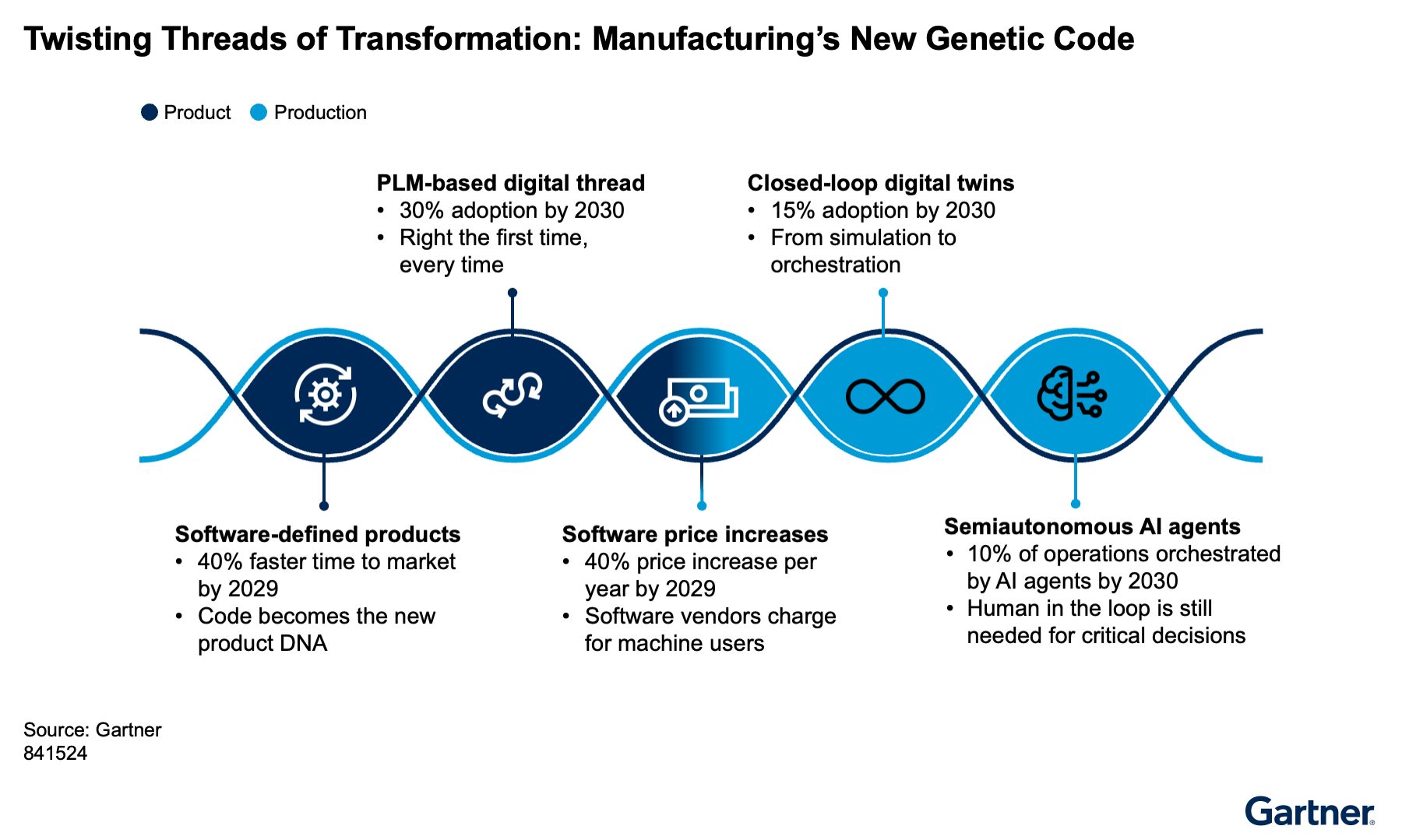
By 2030, the integration of AI agents and digital twins is expected to drive greater autonomy and adaptability in factories and products, while IT costs will increase, in part due to the infusion of AI into core applications that was once the stuff of science fiction. For CIOs and Operations Leaders, the challenge is no longer just “optimization”—it is about building a self-evolving enterprise.
The Dawn of the Software-Defined Product
Historically, hardware was the “body” and software was merely a fixed “organ” embedded within it. But now we are entering the era of the Software-Defined Product, characterized by modular, updatable software running on high-performance edge hardware.
In this new model, code becomes the DNA of the product. Manufacturers are increasingly decoupling hardware and software development processes, allowing them to develop both in parallel—a strategy known as “shifting left”.
Why this matters for your ROI: By 2029, the adoption of software-defined mechatronic products is projected to reduce time-to-market for new features and variants by a staggering 40%, enabling agile responses to market trends and customer feedback. In our opinion, this agility allows firms to respond to market trends and customer feedback in real-time, effectively ending the era of the “static” product release.
Agentic AI: From "Tool" to "Teammate"
The conversation around AI in the factory is shifting from simple Generative AI (GenAI) to Agentic AI. While today’s AI might suggest a fix, we believe tomorrow’s AI agents will autonomously orchestrate operations.
Gartner predicts that by 2030, semiautonomous AI agents will orchestrate 10% of key production operations, quality, and maintenance use cases—a significant jump from the 2% seen today, while humans retain final approval.
- The Guardrail: Humans are not leaving the loop; they are moving to a position of “final approval” for critical decisions.
- The Implementation: This shift will be powered by edge AI platforms with built-in IT/OT connectors, allowing agents to “speak” directly to the shop floor.
The Power of Closed-Loop Digital Twins
We have used Digital Twins (DTs) for years to monitor and simulate. However, we feel the next inflection point is the Closed-Loop Digital Twin. These are not just engineering visualization tools; they are real-time optimization engines.
By 2030, 15% of process manufacturing plants are expected to deploy these closed-loop systems to orchestrate energy usage, asset performance, and production scheduling. The result? A projected 20% reduction in downtime and emissions. These twins ingest real-time data, run optimization models, and send prescriptive control recommendations back to the process.
Weaving the Lab-to-Plant Digital Thread
One of the greatest points of friction in manufacturing is the transition from the laboratory to commercial production. Fragmented material specifications and regulatory data often delay market access.
The solution is a PLM-based digital thread. By 2030, over 30% of process manufacturers are expected to use these product life cycle management (PLM)-based digital threads to manage lab-to-plant transitions and ensure “right the first time” regulatory submissions. This thread orchestrates formulated products across R&D, manufacturing, quality, and compliance, establishing a foundation for AI model training.
Navigating the Rising "Tax" on Intelligence
As manufacturers become more dependent on AI and the cloud, the “cost of intelligence” is rising. Gartner forecasts that by 2029, the annual cost for core manufacturing systems (PLM, MES, and product development software) will rise by 40%.
This increase is driven by several factors:
- Machine Users: Vendors are introducing charges for “nonhuman” accounts—automated systems or scripts that interact with software.
- Cloud Dependency: AI requires massive compute and storage, leading to higher cloud service fees.
- Inflation Adjustments: Software vendors are increasingly adding inflation-linked price hikes.
To mitigate these risks, we believe CIOs must audit master license agreements and negotiate for “flat fees” or capped increases for machine users to maintain budget predictability.
The Road to 2030: Strategic Perspectives
To lead in this autonomous race, organizations must focus on three core pillars for 2026 and beyond:
- The IT/OT/ET Convergence Team: Success no longer happens in silos. We recommend establishing a “Digital Twin Integration Team” that unifies Information Technology, Operational Technology, and Engineering Technology (ET).
- Edge-First AI Readiness: Don’t wait for the cloud. Deploying edge AI platforms with pretrained models can accelerate “time to value” by allowing decisions to be made on the shop floor.
Governance as an Accelerator: In our view, governance is not a roadblock. By institutionalizing AI governance—defining levels of agency by asset and aligning with OT safety standards—you move faster by reducing operational risk.
Building Your Digital Foundation with TEEXMA
We believe navigating these five inflection points requires a software foundation that is as flexible as the “genetic code” described in this Gartner® report. At BASSETTI, we designed our TEEXMA software solutions to be the backbone of your digital thread. TEEXMA is a modular platform that manages technical data from design to manufacturing with a unified source of truth.
By bridging the gap between R&D labs and production plants, TEEXMA allows you to manage the complex mechatronic data of software-defined products while providing the high-quality, contextualized data needed to fuel AI agents and closed-loop twins. Our “no-code” approach ensures that as your production DNA evolves, your software can adapt without the prohibitive costs of custom refactoring, helping you navigate the rising costs of industrial software.
Note: This article includes research from the 2026 Gartner® Manufacturing Predicts: AI Agents, Digital Twins and the Race to Autonomous Operations report. This graphic was published by Gartner, Inc. as part of a larger research document and should be evaluated in the context of the entire document. The Gartner document is available upon request as a complimentary reprint. Gartner, Manufacturing Predicts 2026: AI Agents, Digital Twins and the Race to Autonomous Operations, By Alexander Hoeppe, Jonathan Davenport, et. Al. 10 December 2025. Gartner is a trademark of Gartner, Inc. and/or its affiliates.