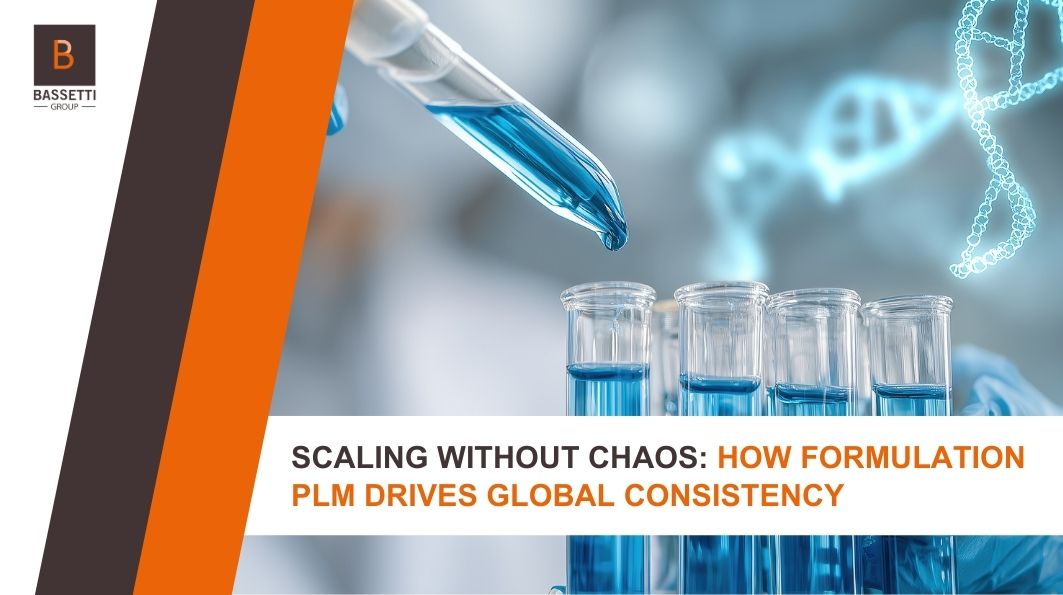
Scaling Without Chaos: How Formulation PLM Drives Global Consistency
The Growth Pain: Fragmented Formulas and Disconnected Sites
Is your company expanding faster than your data can keep up? When new R&D or production sites join your group, whether through organic growth or acquisition, they often bring their own legacy systems: spreadsheets, local databases, and tribal knowledge.
This fragmentation does more than just slow you down; it creates quality silos. In high-stakes industries like cosmetics, specialty chemicals, and agri-food, there is zero margin for error. Whether your product is manufactured in New York, Toronto, or Singapore, the formula must remain the “Single Source of Truth.”
A modern formulation PLM (Product Lifecycle Management) acts as the digital backbone, ensuring that your “Golden Formula” is replicated effortlessly across every entity. It weaves the digital thread that ensures global consistency, turning a collection of disparate sites into a unified, agile enterprise.

Why Formulated Products Require a Specific PLM Strategy
Unlike discrete manufacturing (where you build a car or a phone from solid parts), formulated products are defined by chemistry, molecular interactions, and precise percentages. A minor change—a new raw material supplier or a slight shift in concentration—ripples through your regulatory compliance, labeling, and COGS (Cost of Goods Sold).
R&D and Quality teams globally are currently juggling:
- Cost Control: Managing extreme ingredient price volatility and supply chain disruptions.
- Compliance: Meeting strict, ever-changing FDA, Health Canada, or EU regulations.
- Traceability: Ensuring full “seed-to-shelf” visibility for safety audits.
Without a system designed for the nuances of chemistry, these interactions become impossible to track manually.
Moving Beyond Excel: The High Cost of "Data Debt"
Many companies still rely on “Shadow IT”—heterogeneous tools like Excel, shared drives, or even paper notebooks. While these work for a single lab, they fail during a merger or global expansion. We call this “data debt.”
Data debt compounds every time a formula is tweaked in a silo or a regulatory update is ignored at a local site. When you acquire a new plant, you aren’t just inheriting their equipment; you’re inheriting their data habits.
- The Audit Risk: In an FDA or Health Canada audit, “we couldn’t find the latest version” can lead to massive fines or plant shutdowns.
- Procurement Waste: Without a centralized PLM, you might be buying the same raw material from three different suppliers at three different price points across your sites.
- The Innovation Bottleneck: R&D spends 40% of their time searching for data or re-entering numbers instead of innovating.
Feature Spotlight: Bridging the Gap Between Lab and Label
A PLM isn’t just a filing cabinet; it’s a calculation engine. To rank as a leader in your industry, you need a system that automates “busy work.” Modern systems like TEEXMA for PLM provide specific modules that bridge the gap between chemistry and commerce:
- Automated Regulatory Screening: Imagine a formulator in Montreal testing a new preservative. The PLM can instantly cross-reference the “Prohibited Substances” lists for the US, EU, and China simultaneously. If a concentration exceeds a threshold, the system flags it before a physical sample is even created.
- Dynamic Costing: As raw material prices fluctuate in your ERP, a connected PLM updates your formula’s cost in real-time. This allows R&D to design “to a price point,” ensuring profitability is baked in from day one.
One-Click Ingredient Statements: Generating an INCI list or a Nutrition/Supplement Facts panel is traditionally a multi-day manual task. In a unified PLM, this is a 30-second export.
Formulation PLM as the Digital Thread
A formulation-centric PLM provides a structural answer to growth challenges. It does more than just centralize information: it creates a continuous digital thread around the formula, from the research phase to industrialization and market launch.
Ingredient data, formulation rules, quality validations, and regulatory requirements are interconnected in a unique and controlled environment. The validated formula becomes the shared reference for all teams and sites, ensuring consistent execution across the group. This digital continuity makes it possible to anticipate the impacts of changes, secure validations, and accelerate decision-making without multiplying manual checks.
Strategic Onboarding: Turning New Sites into Profit Centers
When a new production or R&D site joins the group, the ability to quickly deploy best practices is your primary KPI. Formulation PLM facilitates this “onboarding” (or site integration) by relying on harmonized processes and standardized data.
The formulation PLM facilitates this through “template-based scaling”:
- Standard Operating Procedures (SOPs): Instead of sending a team of engineers to a new site for six months, you “push” the digital manufacturing instructions and quality checkpoints directly to their local instance.
- Localized Flexibility within Global Guardrails: A site in Singapore might need to swap a specific thickener due to local supply chain issues. A formulation-centric PLM allows for this “local variant” while maintaining a link to the “global parent” formula.
Each site works from the same repositories. Deviations are controlled, local adaptations are framed, and skill development is accelerated. The company can thus grow without compromising the consistency of its products.
From Operational Mastery to Competitive Advantage
By structuring formula management, formulation PLM transforms operational constraints into performance levers. It reduces the risk of non-compliance, improves collaboration between R&D, Quality, and production, and significantly shortens development cycles.
Above all, it frees up time for the essential: innovation. By relieving teams of manual consolidation and verification tasks, the PLM allows them to focus on value creation and product differentiation.
The shift to a formulation PLM is no longer a luxury—it is a survival requirement in a market defined by rapid consumer trends. Whether it’s the “clean beauty” movement in cosmetics or “low-sodium” mandates in food, your ability to reformulate and deploy those changes across 10 sites instantly is your greatest competitive advantage.
Ready to unify your global R&D operations?
Switching to a formulation PLM means evolving formula management from a set of disparate practices to a structured, scalable system aligned with your company’s growth ambitions.
Discover how our solution TEEXMA for PLM, specifically designed for the chemicals, cosmetics, and agri-food sectors, can integrate into your existing ecosystem and accelerate your product launches.