

Transforming Facility Management: Digital tools for efficiency and performance
Facility management (FM), traditionally focused on building stewardship and general services, is today profoundly impacted by digital transformation. This transition to digital, characterized by the adoption of cutting-edge technological tools, is transforming infrastructure management, bringing about greater agility, efficiency, and reactivity in daily operations.
It’s important to evaluate how digitalization is redrawing the boundaries of facility management by exploring its definitions, the challenges it poses, the essential features of digital tools, and the benefits it provides.

What is Facility Management? A Modern Vision
Facility management, in its modern form, encompasses all the services essential to the proper functioning of an organization’s buildings, equipment, and infrastructure. It covers a wide range of areas, ranging from space management and equipment maintenance to energy consumption monitoring, security, cleaning, and much more.
This crucial function has the main objective of supporting the organization’s activities while optimizing costs and improving occupant comfort. However, the advent of digital transformation has profoundly changed this traditionally operational area, giving it a more strategic dimension. FM is no longer limited to simple day-to-day management; it now relies on technology to offer intelligent, proactive, and integrated solutions.
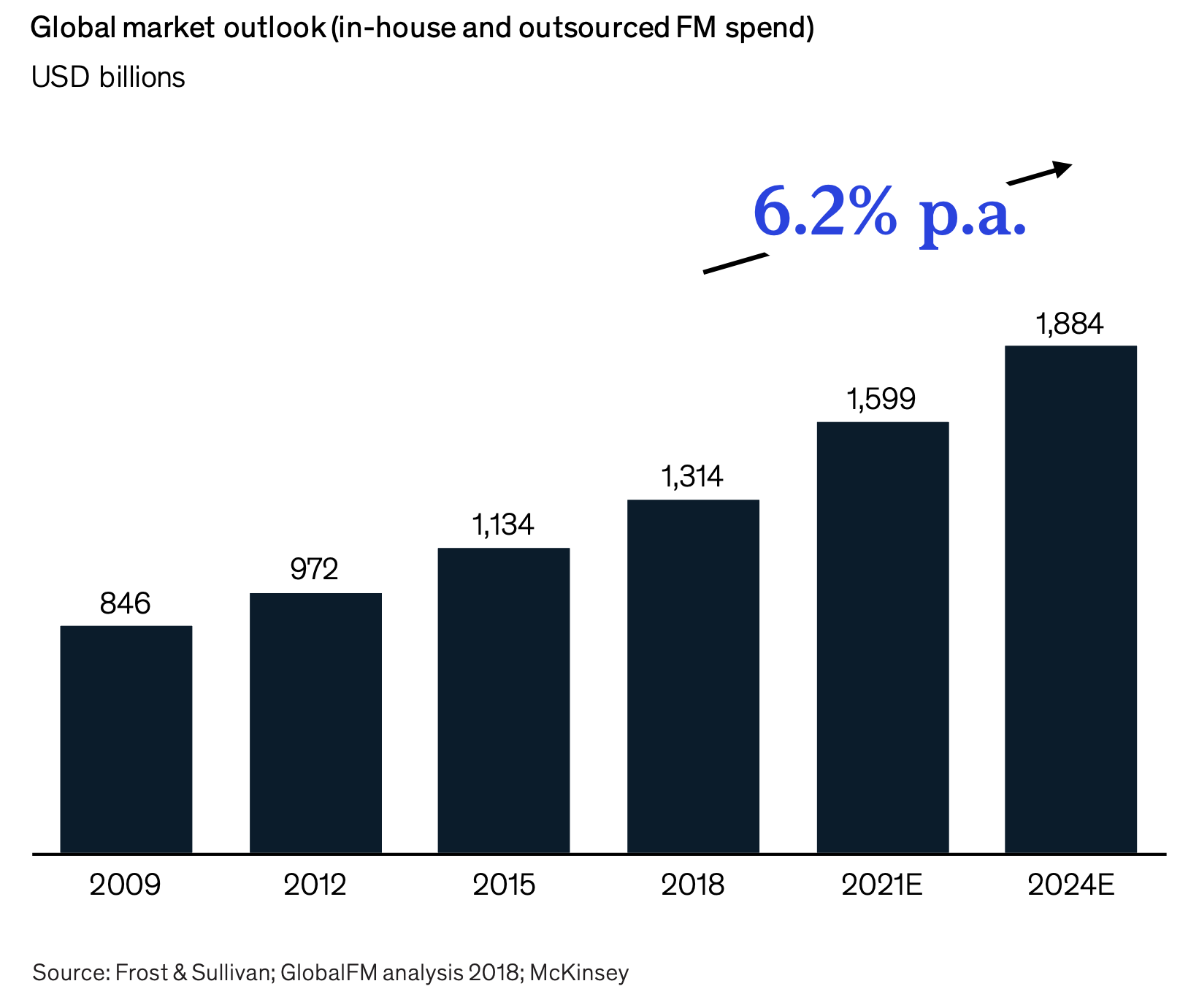
In addition, a McKinsey study reveals that the financial weight of facility management has been constantly increasing for several years. It has doubled in five years and continues to grow by an average of 6.2% per year.
This trend, in addition to reflecting a thriving market and a shift toward outsourcing services, highlights the growing interest that organizations have in facility management.
How Is Digitalization Transforming Facility Management?
1. Improved Operational Efficiency:
Digital systems provide better business management and enable the automation of repetitive, low-value tasks. This results in reduced time spent and operating costs.
2. Full Integration:
Thanks to the diversity of available tools such as sensors, connected equipment, energy systems, and BIM, interoperability and automated data exchange become possible. This facilitates centralized information management and automates processes that can be automated.
3. Full Coverage:
In large environments, digitalization ensures end-to-end control of data, from initial acquisition to renovation work. It allows complete management of the real estate process.
4. Real-Time Tracking:
The Internet of Things (IoT) and smart sensors make real-time monitoring of buildings possible. This makes it possible to anticipate breakdowns, optimize energy consumption, and guarantee user safety.
5. Optimized Cost Management:
Collecting and analyzing data through digital tools helps identify sources of inefficiency. This leads to optimized resource use and long-term cost reduction.
6. Improving Employee Wellbeing:
Digital solutions make it easier to design workspaces according to employees’ needs (smart office). This improves comfort and productivity.
7. Activity Structuring and Traceability:
IT tools enable activity management based on standardized processes and data. All activity is capitalized in a uniform and organized manner, facilitating subsequent use of the data (research, indicators, predictive analysis, etc.).
8. Data and Document Centralization:
Faced with the multiplicity of software in organizations, digitalization offers centralized data management (business scope, equipment software, sensor data). This makes it easier to leverage this valuable data.
9. Environmental Impact Analysis and HSE Policy:
Through the monitoring of energy consumption, the tracking of suppliers, and the digitalization of prevention plans, it becomes possible to measure and analyze the organization’s HSE approach. According to a study by Gartner, by 2025, more than 50% of organizations will use smart building tools to optimize the occupant experience and reduce their carbon footprint.
The Key Benefits of Digitalizing Facility Management
The digital transformation of Facility Management brings many substantial benefits, affecting organizations, property managers, and occupants alike. These benefits are manifested in several ways:
1. Cost Control:
By optimizing resources, particularly energy resources, and through total control of data, organizations can significantly reduce their operating costs.
2. Time Savings and Increased Efficiency:
Process automation allows managers to focus on more strategic tasks, while management tools facilitate real-time monitoring of operations.
3. Increased Sustainability and Reduced Environmental Impact:
Energy management tools help track and reduce energy consumption, contributing to more environmentally friendly building management. A well-managed building can achieve better environmental performance, aligning with sustainable development policies.
4. Improved User Experience:
Digital solutions provide intelligent services that better meet user needs such as thermal comfort, optimized lighting, and flexible workspaces.
5. Enhanced Security:
Real-time monitoring, combined with IoT, enables better management of infrastructure security risks, with automatic alerts in the event of failures.
TEEXMA for Maintenance: Digital Transformation for Facility Management
Faced with these major digitalization challenges, organizations need robust and adaptable tools. With this in mind, the BASSETTI Group developed TEEXMA for Maintenance, a complete and innovative software solution designed specifically to meet the needs of modern facility management.
TEEXMA for Maintenance offers a centralized platform for operations management, equipment maintenance, cost tracking, and intervention planning. With its advanced features, the platform promotes improved operational efficiency, data integration, real-time monitoring, cost management, and optimization of occupant well-being. It also enables detailed analysis of environmental impact and rigorous management of HSE policy, in line with current sustainable development challenges.
The Future of Facility Management: Toward Smart, Sustainable Operations
As organizations continue to embrace digital transformation, Facility Management is evolving into a central pillar of strategic decision-making. The integration of IoT sensors, Building Information Modeling (BIM), and artificial intelligence enables facility managers to access real-time insights into asset performance, energy use, and occupant comfort. These technologies help create smart buildings capable of self-monitoring, predictive maintenance, and data-driven optimization.
Moreover, sustainability has become a defining factor in modern Facility Management. Digital solutions provide precise tracking of energy efficiency, waste reduction, and carbon footprint metrics, allowing companies to align with environmental and regulatory standards. The result is a new generation of intelligent, eco-efficient infrastructures that combine cost savings, safety, and occupant well-being.
In this context, investing in innovative digital platforms is no longer optional but essential for organizations seeking to remain competitive. By adopting advanced Facility Management software such as TEEXMA for Maintenance, companies can unify operations, anticipate issues, and achieve measurable improvements in efficiency, sustainability, and long-term performance.